What's new in 2.2.0
SoilIQ 2.0 was a ground-up rebuild. SoilIQ 2.1 refined it. SoilIQ 2.2.0 expands what the app knows — and who it helps.
The headline feature in this release is LawnIQ: a lawn guidance system built directly into SoilIQ. It takes everything the app already does — four-depth soil temperature readings, a 14-day forecast, growing degree day tracking, location-specific context, and probe calibration — and applies it specifically to lawn care. Mowing, watering, seeding, overseeding, green-up timing, pre-emergent windows, heat stress risk. The same soil intelligence that helps gardeners know when to plant now helps lawn owners know when to act.
This release also deepens how the app handles Lawn Activity logging, so LawnIQ can see what you've actually done and adjust its guidance accordingly. If you mowed yesterday, it knows. If you watered this morning, it considers that. Guidance that tracks your activity becomes meaningfully more useful than guidance that doesn't.
Everything else in the app — PlantAI™ for 130+ crops, the 14-day soil forecast, frost alerts, widgets, Live Activity, Apple Watch, and Siri — is still here, still free, still improving. 2.2.0 adds a new dimension to a platform that was already deep.
Meet LawnIQ
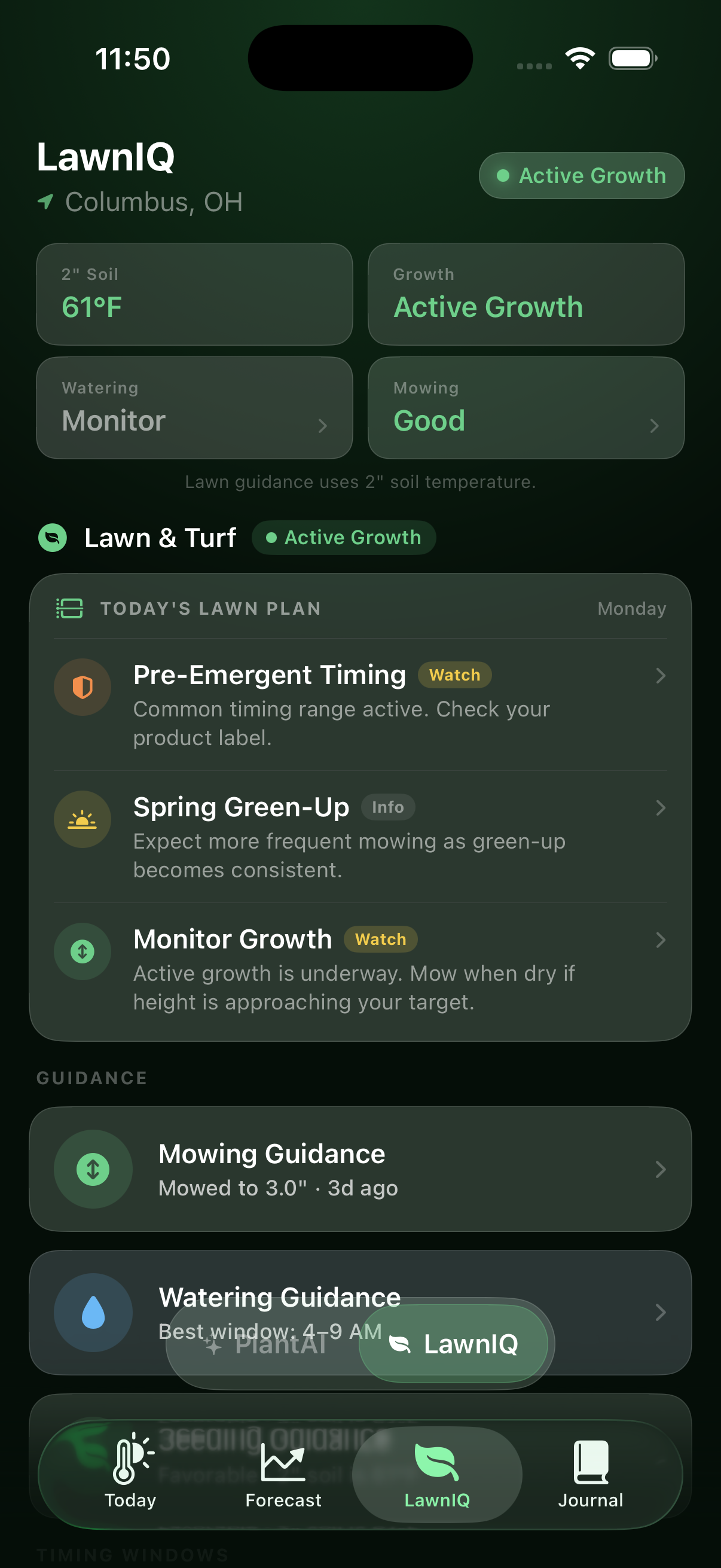
LawnIQ lives inside SoilIQ. It's not a separate app, a subscription service, or a chatbot. It's a guidance layer that reads your soil conditions and forecast, considers your grass type and lawn goals, and gives you specific timing guidance — right now, for your lawn.
Stop guessing. Let the soil decide.
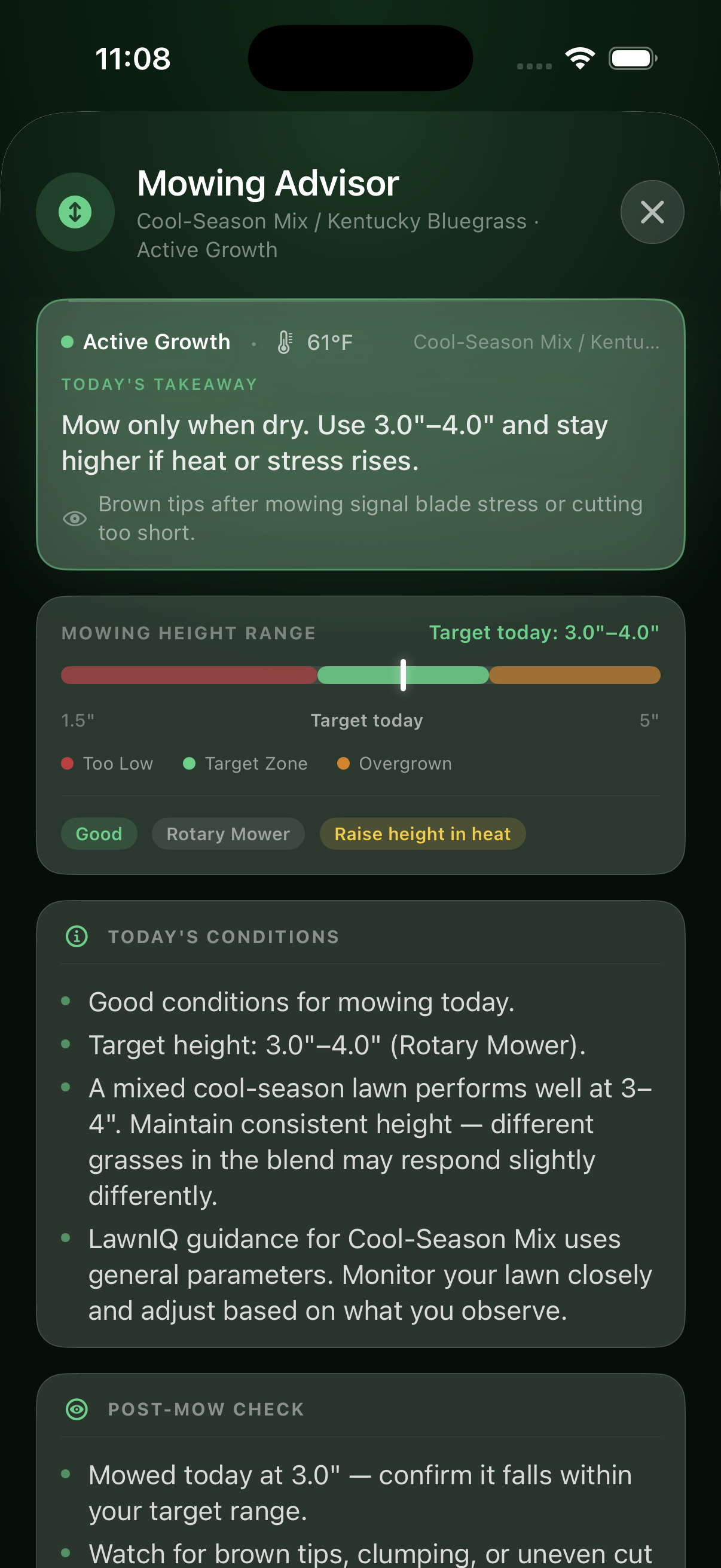
LawnIQ surfaces timing guidance across every dimension of lawn care — not as a static checklist, but as live signals that update as your soil and forecast change. Open the app and see exactly what conditions say about today.
Every recommendation is tied to a reason. Rain is coming. Heat is building. Soil is warming into the seeding window. LawnIQ tells you what and why — because understanding the signal makes you a better decision-maker, not just a follower of instructions.
- Mowing windows
- Watering guidance
- Seeding & overseeding timing
- Heat stress risk
- Pre-emergent timing
The key design principle behind LawnIQ is that timing matters more than technique for most lawn decisions. The right guidance for a lawn that received rain yesterday is different from the advice for one heading into a dry heat stretch. The best mowing window tonight depends on whether it rains tomorrow. LawnIQ doesn't serve the same answer to everyone — it reads your data and responds to what's actually happening.
LawnIQ sits alongside PlantAI™ in the dedicated guidance section of SoilIQ and updates automatically as your soil data refreshes.
Why soil temperature matters for lawns
Most lawn advice runs on calendar dates. Plant ryegrass in September. Fertilize in April. Aerate in fall. The problem with calendar-based advice is that it ignores what's actually happening in the ground — which varies dramatically by location, elevation, microclimate, and year-to-year weather variation.
Soil temperature is the signal that doesn't lie. It reflects the cumulative thermal state of the soil: not just what the air was like today, but what it's been doing for weeks. It's more stable than air temperature and more directly relevant to what roots, seeds, and soil microbes are actually experiencing.
For seeding and overseeding, soil temperature determines whether seed will germinate — and how quickly. Cool-season grasses like tall fescue, Kentucky bluegrass, and perennial ryegrass germinate best within a specific soil temperature range. Outside that range, seed either sits dormant, rots, or germinates weakly and struggles to establish. LawnIQ tracks where your soil sits relative to these windows and lets you know when conditions are right — and when to wait.
For watering decisions, soil temperature interacts with evapotranspiration rates. In cool, cloudy periods, moisture lasts longer. In high-heat stretches, the soil dries faster — especially near the surface. LawnIQ uses your forecast to help you understand when the soil is likely to be under pressure and when you can scale back without risk.
For pre-emergent timing, soil temperature is more accurate than any calendar rule. The window for controlling common weed species is tied to soil conditions at a specific depth — and that window shifts by weeks depending on the year. LawnIQ surfaces the approach of that window so you're not caught off guard by an early spring or a late cold snap.
SoilIQ tracks soil temperature at four depths — surface, 2 inches, 6 inches, and 21 inches. For most lawn decisions, surface and 2-inch readings are most relevant. For deep-rooted turf health and seasonal dormancy tracking, the 6-inch depth tells a different and equally important story.
What LawnIQ helps you decide
LawnIQ covers the full set of recurring timing decisions that come up in lawn care throughout the season. The app doesn't tell you how to mow or what products to use — that's for product labels and your own judgment. What it does is tell you when, based on what your soil and forecast are doing right now.
Mowing windows
LawnIQ evaluates current conditions and the near-term forecast to surface mowing timing guidance. If significant rain is coming in 24–36 hours, tonight may be a better window than waiting. If a heat spike is building over the next few days, mowing earlier in the week — before the lawn is under thermal stress — is the better call. Guidance is built around your actual conditions, not a generic "mow once a week" rule.
Watering guidance
LawnIQ helps you avoid two common watering mistakes: watering just before rain comes (wasting water and potentially stressing the lawn) and skipping watering during a dry stretch that's harder to see on a calendar. The app considers incoming precipitation, recent soil moisture context, and current temperature trends when surfacing watering guidance.
Seeding and overseeding timing
Seeding windows depend on soil temperature more than anything else. LawnIQ tracks where your soil temperature sits relative to the germination range for your grass type and flags when conditions are approaching, open, or closing. It also considers the 14-day forecast — a seeding window is only useful if the soil stays in range long enough for germination to begin and establish.
Spring green-up and fall preparation
Seasonal transitions are where timing matters most. LawnIQ uses soil temperature trends to identify where your lawn is in its seasonal arc — still dormant, entering active growth, or approaching the cool-season transition. These signals help you know when to start a fertilization program, when to scale up mowing frequency, and when to prepare for the next season.
Heat stress risk
High air temperatures combined with soil that's already warm create stress conditions for cool-season grasses. LawnIQ surfaces heat stress risk windows so you can adjust mowing height, hold off on fertilizing, and water more strategically before the stress window arrives — not during it, when the damage is already happening.
Pre-emergent timing
LawnIQ tracks the soil temperature signal that marks the approach of the pre-emergent application window for common weed species. This is surfaced as a timing indicator — always with the reminder that product selection, application rates, and local regulations are the user's responsibility. LawnIQ provides the timing signal; the decisions are yours.
LawnIQ guidance is tied to a reason, not just a verdict. The app doesn't only say "good mowing window" — it surfaces the signal behind it. Rain is coming. Heat is building. Soil is warming into the seeding range. Knowing why a window is opening or closing helps you make better decisions, not just follow instructions.
Lawn Activity and Field Notes
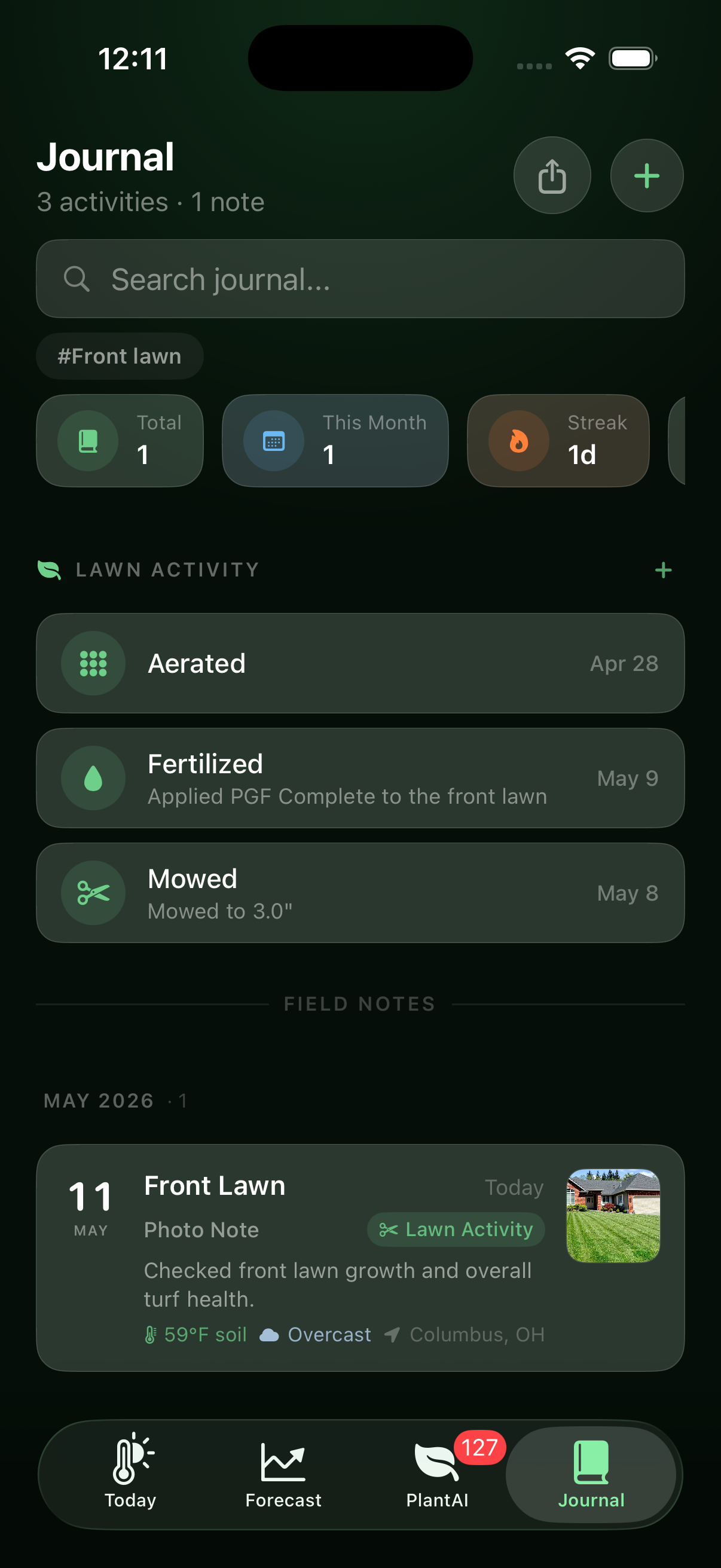
LawnIQ becomes more useful the more the app knows about what you've actually done. That's where Lawn Activity logging comes in.
Guidance that knows what you've done.
Log mowing sessions, watering events, seeding, fertilization, and pre-emergent applications directly in the app. LawnIQ considers your logged history when surfacing guidance — so it won't suggest watering after you already ran the irrigation, or recommend overseeding two weeks after you just seeded.
Every entry automatically captures soil temperature at all four depths at the moment you log it. Over time that builds a real record: what the soil was doing when the overseeding took, what conditions preceded a bad germination, what actually worked at your location and in your soil.
Attach up to four photos per entry and write free-form Field Notes alongside. It's the kind of contextual record that makes every future season smarter than the last — tied to real conditions, not calendar guesses.
Field Notes let you attach free-form observations to any logged activity — what the lawn looked like, what you noticed, what you used. Every note is timestamped alongside the soil data from that moment, so you can build a real record of what works at your specific location in your specific soil.
Photos are supported too — attach up to four images per entry from your library. When you look back at a seeding from last September, you can see what the lawn looked like, what the soil temperature was, and what you noted at the time. That's a different kind of lawn knowledge than anything a generic lawn app can offer.
PlantAI and LawnIQ side by side
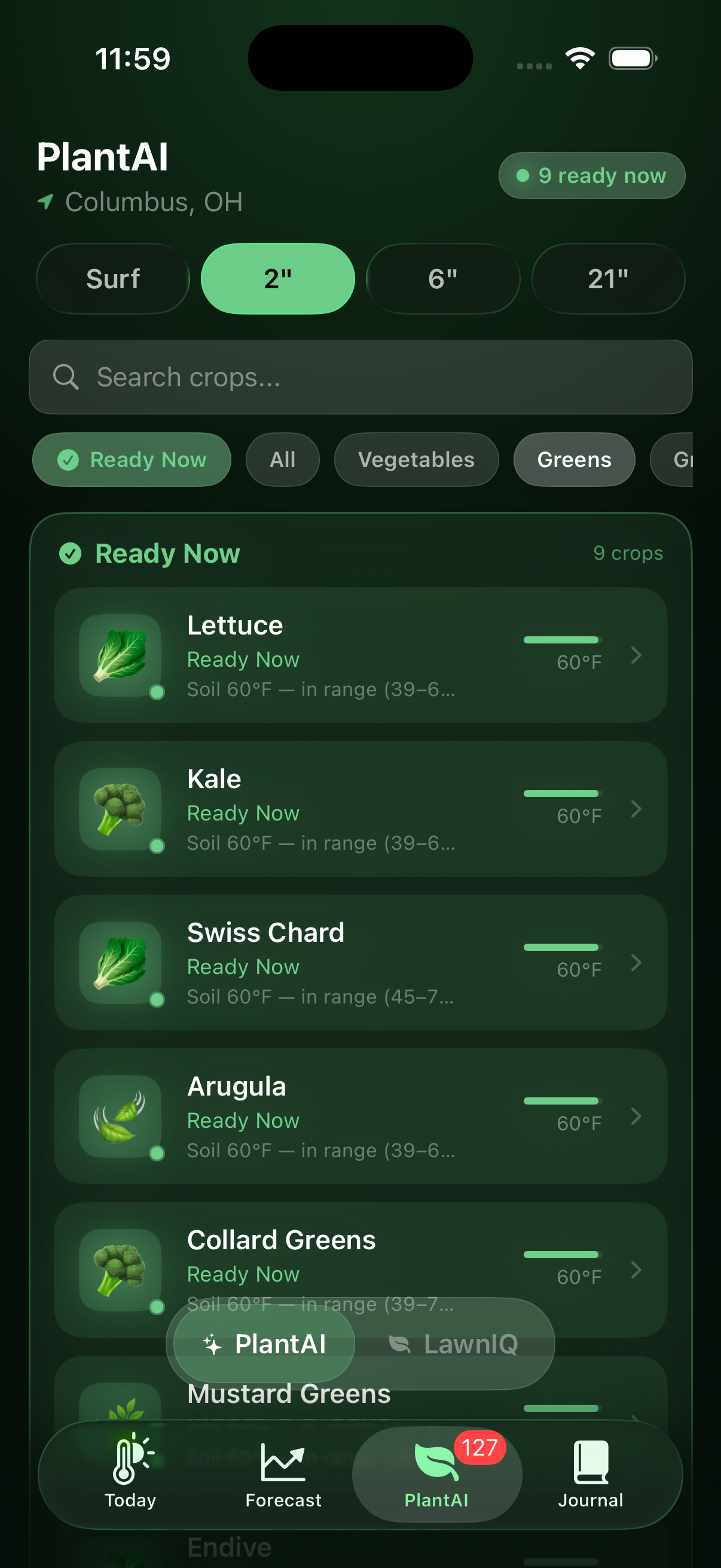
SoilIQ now has two guidance systems running in parallel. They're built for different jobs, and they complement rather than duplicate each other.
PlantAI™ is built for the garden and the field. It evaluates 130+ crops across 13 categories — vegetables, herbs, grains, cover crops, fruit, and grasses — against your current soil conditions and classifies each into one of four readiness states: Ready Now, This Week, Coming Up, and Not Yet. PlantAI answers the question "what can I plant right now?" across the full range of edible and agronomic plants.
LawnIQ™ is built for the established lawn. It doesn't ask what you can plant — it asks what you should do with the lawn you already have. Mowing, watering, overseeding, managing heat stress, preparing for winter, greening up in spring. LawnIQ is the operational layer of lawn management: timing the recurring decisions that every homeowner, groundskeeper, and lawn creator makes throughout the season.
Two systems. One platform.
PlantAI handles first planting — seed selection and germination readiness. LawnIQ handles everything after: all the recurring decisions that keep an established lawn healthy through the season. Use PlantAI to know what grass to seed and when. Use LawnIQ to manage the lawn once it's in the ground.
Both systems read from the same soil data. The soil temperature reading that tells PlantAI that tall fescue is in its optimal seeding window is the same reading that tells LawnIQ that an existing lawn is moving out of spring dormancy into active growth. One dataset. Two lenses. A more complete picture of what your soil is telling you.
Your location. Your lawn.
Generic lawn advice fails because lawns are local. A mowing schedule that works in Seattle is wrong for Phoenix. A pre-emergent window that makes sense in Georgia is two months off in Minnesota. The soil doesn't care about the national average — it responds to the actual weather at your actual location.
SoilIQ has always been location-specific, and LawnIQ inherits that foundation. Every guidance signal in LawnIQ is tied to your current location — not a regional average, not a USDA hardiness zone lookup, but the soil temperature model for your exact coordinates and the 14-day forecast for your spot on the map.
SoilIQ Pro users can save multiple locations. If you manage a front yard and a back yard with meaningfully different exposure, or a property at a different elevation, each location gets its own data and its own LawnIQ guidance based on what's actually happening there. Switching between locations is instant — the app loads from cache and shows each location's context immediately.
Check your soil right now.
See your soil temperature at four depths, what LawnIQ is recommending today, and what the next 14 days look like for your lawn.
Probe calibration
LawnIQ is only as good as the data behind it. For most users in most locations, the soil temperature model that powers SoilIQ is accurate enough to be immediately useful. But no model is perfect for every microclimate — and lawns, in particular, have a way of developing their own.
A south-facing lawn with dark mulch at the edges and an irrigation system running three mornings a week will behave differently than the open-field model predicts. A heavily shaded backyard stays cooler longer in spring. A raised section over compacted fill drains faster and warms faster. These aren't failure modes in the model — they're the reality of residential lawns.
Probe Calibration lets you close that gap. Take a reading with a physical soil thermometer at any of the four depths, enter it in the app, and SoilIQ stores the offset. From that point forward, LawnIQ uses your calibrated reading — your actual soil, at your actual location — rather than the raw model output. The offset can be updated or cleared any time without affecting your activity history.
One calibration measurement can meaningfully sharpen LawnIQ guidance. If your lawn consistently runs warmer or cooler than the model estimates — due to irrigation patterns, mulch cover, shade, or soil composition — a single probe reading at the most relevant depth gets LawnIQ working from your actual conditions, not the grid average.
iPhone, iPad, Apple Watch, and beyond
SoilIQ is a universal app. LawnIQ guidance is available everywhere the app runs — which in 2.2.0 means iPhone, iPad, and Apple Watch, plus home screen widgets, the lock screen via Live Activity, and Siri.
Apple Watch
Glance at your wrist for current soil temperature, conditions summary, and moisture context. Stays in sync with your iPhone automatically — no extra API calls, no extra battery drain.
iPad
SoilIQ adapts to a full sidebar layout on iPad, with content views optimized for the larger canvas. If you manage a property from a tablet, the app is built for it.
Home Screen Widgets
Small, medium, and large widget sizes. The large widget includes a 5-day soil temperature forecast bar chart. All widgets refresh immediately when the app fetches new data.
Live Activity
Enable the Live Activity in Settings and your current soil temperature shows on the lock screen and in the Dynamic Island — updated in real time without opening the app.
Siri
App Intents let you ask Siri about your current soil temperature or conditions. Quick access without unlocking your phone or navigating into the app.
Offline Mode
All cached data loads instantly with no network connection. Your last known readings and forecast stay accessible even when you're in the field without signal.
SoilIQ Pro
The core SoilIQ experience — four-depth soil temperature, LawnIQ guidance, PlantAI™ for 130+ crops, the 14-day forecast, frost alerts, the Apple Watch app, Live Activity, home screen widgets, Siri, Field Notes, and probe calibration — is completely free. All of it.
SoilIQ Pro unlocks unlimited saved locations. The free tier includes one saved location. Pro users can save as many locations as they need, each with its own LawnIQ context, PlantAI data, and location-specific forecast. Pro is $4.99/month or $29.99/year, with a 7-day free trial — enough time to see exactly how the full experience works before committing.
If you manage multiple properties, a large garden alongside a lawn, or you want to track soil conditions at different spots on the same plot, Pro is the unlock that makes that seamless.
Why this update matters
When we built SoilIQ 2.0, the goal was to give growers — gardeners, farmers, homesteaders — the soil intelligence they'd been missing. PlantAI was the first proof of that concept: take the same soil temperature data that agronomists rely on and make it accessible, specific, and actionable for anyone with an iPhone.
LawnIQ is the same idea applied to a much larger audience. There are more lawn owners in North America than there are food gardeners. Most of them have never thought about soil temperature as a variable in their lawn care. They follow calendar rules, guess at watering schedules, and wonder why their overseeding doesn't take every other fall.
LawnIQ gives those users something they've never had: lawn guidance that responds to what their soil is actually doing. Not the calendar. Not the generic advice on the seed bag. Not a national average. Their soil. Their forecast. Their lawn.
That's what "Stop Guessing. Plant by Soil." means for lawn owners in 2.2.0.
Get SoilIQ 2.2.0
SoilIQ 2.2.0 is a free update for existing users and a free download for anyone new. Update from the App Store or download now — LawnIQ is waiting on the first launch.
If you've been using SoilIQ for the garden, open the app after updating and explore the LawnIQ section. Set your grass type, log your first lawn activity, and let the soil start informing your lawn decisions the same way it's been informing your planting ones.
SoilIQ 2.2.0 — Free on iPhone, iPad & Apple Watch
LawnIQ, PlantAI for 130+ crops, 14-day soil forecast, frost alerts, Live Activity, home screen widgets, Apple Watch, Siri, Field Notes, and probe calibration. No subscription required for core features.